by Lara Just, October 2026.
Are we so busy trying to catch up with life that we forget to enjoy it?
I started writing this article in September. Now it’s October, and I’m finally getting around to finishing it.
There’s something rather ironic about that, considering it’s about never having enough time!
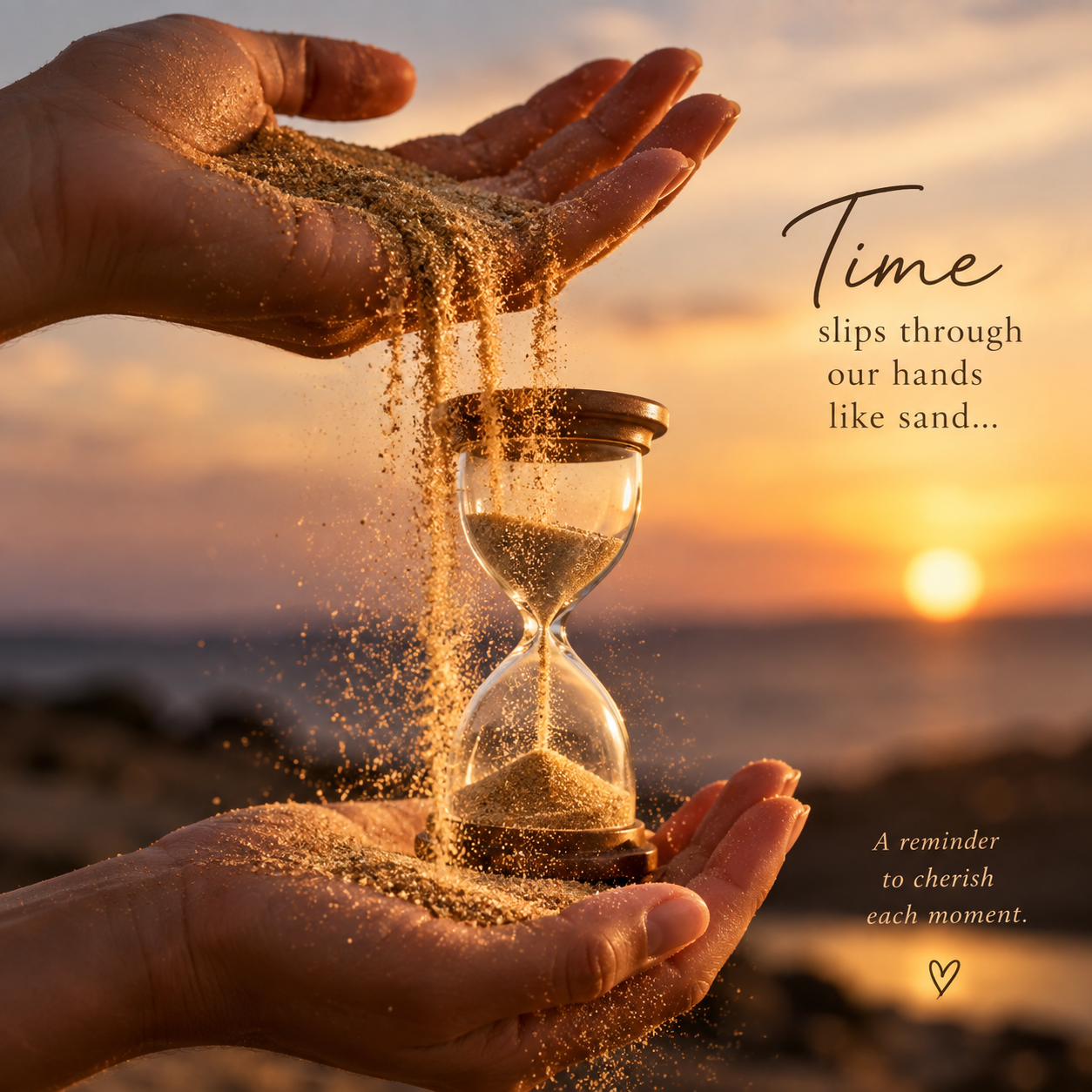
It began with a feeling I couldn’t quite put into words. I even searched for an emoji to describe it, eventually creating an image with AI: an hourglass, with golden sand slipping through a pair of hands.
It captures something surprisingly well.
A day begins with so many possibilities. Before I know it, lunchtime has arrived, emails are multiplying, the dog needs walking — and meditation, exercise, journalling and that book I’ve been meaning to read remain good intentions.
And somewhere in the background sits the never-ending to-do list and unfinished projects.
When will everything finally be finished?
Over the past few years, I’ve moved home, worked on my house and garden, and accumulated more unfinished projects than I care to think about. Some I chose, others decidedly not!
I’ve realised how much I like completing things. There’s a wonderful sense of satisfaction in ticking something off, imagining the space it will create for something else.
But I’ve also noticed something rather unsettling.
I wonder whether we’re waiting for life to become less busy before we can properly enjoy it.
Perhaps you recognise that feeling?
Once I’ve finished this project, sorted out my finances, cleared the backlog, organised the house… then I’ll have more time.
Except there’s always something else. The washing basket fills again. Another email or message needing a reply arrives.
And life, of course, doesn’t wait for us to finish our lists.
Why does time seem to disappear?
Psychology offers some interesting explanations.
The Zeigarnik effect describes how unfinished tasks may stay active in our minds, even when we are not working actively on them. This can make switching off surprisingly difficult. It doesn’t explain every experience, but perhaps it helps us understand why an apparently free afternoon doesn’t always feel free.
Our perception of time is also remarkably flexible. Five anxious minutes can feel endless, while an afternoon spent doing something we love seems to vanish. Attention, emotions and memory all play a part in this.
In my work as a psychotherapist, I hear people of different ages wondering where the weeks and months have gone. It’s certainly not just about getting older.
Then there’s technology. We have more ways than ever to save time, yet our days seem fuller. Even a walk that might have been a mindful pause can become an opportunity to answer messages or get something else done.
Perhaps the question isn’t simply whether time is moving faster, but are we living faster? Is time really the problem, or is it how we’re living within it?
I’m also curious about spiritual perspectives on time and consciousness. They aren’t established scientific explanations yet, but they invite us to keep questioning how we experience reality.
What does giving ourselves permission actually mean?
Since starting this article, my perspective has shifted a little.
It’s not that I want to do nothing, or necessarily much less. I want to live more freely, with more space and less pressure in between.
To read, learn, explore, walk, spend time with people, follow my curiosity and sometimes simply enjoy an afternoon — without always feeling that something else should come first, or without worrying about everything I haven’t done.
Of course, there are realities we cannot ignore. There are bills to pay, work commitments, people who depend on us and practical responsibilities that won’t disappear.
But perhaps giving ourselves permission doesn’t mean escaping or abandoning those responsibilities.
Maybe it’s recognising that not everything is equally urgent, and we don’t have to complete everything before we’re allowed to enjoy something.
Maybe slowing down isn’t another task to add to the to-do list. It could begin with allowing a walk to be just a walk, enjoying a conversation without checking the time, or reading a few pages without feeling guilty.
Not another thing to achieve. Just a moment to experience.
A different way of looking at time
In September, the Soulfarer Book Club I run here in Hayle, Cornwall, read The Midnight Train by Matt Haig, prompting reflections on life, memories and the moments that shape us.
It brings me back to that hourglass.
When we watch sand falling, we tend to focus on what’s disappearing.
How much time do I have left? How quickly is it going? What haven’t I done yet?
But there’s another way to look at it.
The sand hasn’t vanished. It’s collecting below.
Perhaps that lower half represents everything our time has already become: experiences, relationships, conversations, adventures, mistakes, love, loss and ordinary moments as part of a life already lived.
And as autumn reminds us, perhaps not every season needs to be about achieving, producing or finishing things.
Perhaps our task isn’t to stop the sand from falling.
Maybe it’s to become a little more conscious of where we are while it does.
For any comments or questions on this article or to enquire about sessions, feel free to contact me.